A B C D E F G H I J K L M N O P Q R S T U V W X Y Z
Showing posts with label RPG Brainstorming. Show all posts

Saturday, June 9, 2012

RPG Brainstorming: Nu Sinistra


Working on fresh Humanspace Empires RPG stuff in-between a few other projects led us to another old post from the Netherwerks blog that didn't make the transition cleanly. Speculating about the space opera pre-history of Prof. M. A. R. Barker's brainchild Tekumel is all well and good (and quite a lot of fun!)...but what happens if...when...the Lords of Humanspace begin to reconnect with those 770 or so worlds that got 'lost'?

Now that could form the basis of a really intense Space Opera/Sword & Planet mash-up RPG that we'd really like to see...

Reconciliation and Apocalypse during the End of All Known History as powerful interstellar forces reconnect, reconnoiter and forcibly recover hundreds of lost worlds severed from the main universe during a cosmic disaster that plunged them all into their own pocket domains for millennia.  Not all those worlds that have been lost want to be rediscovered or recovered.  One in particular is fighting back and they have gods on their side...

(...With 700+ possible worlds to go muck around with, you don't even have to screw-up Tekumel. Neat.)

Friday, March 30, 2012

RPG Brainstorming: Radioactive Skeletons

A lot of fringe-ish and anomalous phenomena focused web-sites continue to circulate and propagate the meme of radioactive skeletons found at places like Mohenjo Daro or Harappa that somehow 'prove' prehistoric nuclear weapons.

One of the more well thought-out and skeptical dissections of this particular recurring internet-meme can be found at Twitscope. The comments alone are quite interesting, but they do get heated fairly quickly and it wouldn't do to get too caught-up in the political, religious or other debates surrounding this stuff. What we're looking for is something interesting to mess around with in a story or a game, so we're neither advocating nor debunking any of this stuff. We just like the idea and want to see what we can do with it in a fictional and/or gaming context. So Caveat Emptor, make sure you're carrying some (or a lot of) salt, and please don't believe everything just because it's on the internet.

'Evidence' for Ancient Nuclear Wars
So did something nuclear happen way back when? Who really knows? But take a step back from it all and take a good look at this stuff from the perspective of 'What If?'

Six Quick Scenario-Ideas
  1. An archaeological expedition uncovered an ancient ruined civilization where the ruins really are filled with radioactive skeletons...
  2. Some adventurers discovered a series of caverns that opened up into a complex of tombs and temples filled with radioactive skeletons. Does the usual curative magic work on radiation poisoning? Can radioactive skeletons be reanimated?
  3. Intrepid Interplanetary Explorers uncover a shaft leading deep below the blasted crust of a dead world only to find themselves confronted with a vast underground arcology littered with the radioactive skeletons of some previously undiscovered xenomorph species. 
  4. Some enterprising alchemist discovers that by grinding up the remains of the so-called 'smoldering mummies' from the arid regions of some notorious hinterland they can be used to give his otherwise unspectacular concoctions a real bit of oomph, except that a week or so later everyone who experienced such a miraculous cure seem to be wasting away.
  5. A cadre of ultra-secret government operatives gain access to a tunnel revealed in an old prospector's diary. The tunnel runs under the Andes mountains and beyond, possibly linking into some sort of synchronized tunnel network that spans multiple worlds or timelines. The first major chamber they find is a massive catacomb-system where each niche is heaped with distorted, radioactive skeletons of things that might not have been wholly human.
  6. The tripodal mucoids were not all destroyed in their disastrous invasion of Earth. A secret cabal of survivors went underground, deep below Olympus Mons, and worked for decades on a vengeance weapon that would redeem their defeat by simple microbes. There, in hermetically-sealed bunkers, the mucoids have been perfecting the means of animating the skeletons their agents have been stealing in order to saturate them with high levels of ionizing radiation and releasing them upon an unsuspecting populace of colonists as terror weapons.
Any other ideas?

Wednesday, October 5, 2011

RPG Brainstorming: Underground Playground

You Tube continues to provide a lot of fun resources for re-thinking stale old tropes or for incorporating real world stuff into fiction and games. A lot of the actual and factual is ten times more unbelievable than anything made-up. If you can look past the breathless proponents of various agendas and whatever theories, and just examine the ideas involved in some of this stuff, it starts to provide all sorts of great fodder for developing any number of scenarios and adventures for just about any style of paper-and-pencil RPG. Case in point, let's take a look at this documentary 'Underground Species and the Hollow Earth.' It'll make a nice appetizer for the Hollow Earth and related post(s) coming up shortly.

Part One:


Aside from the 'Sky God(s)', UFO-nauts, and all that stuff, the actual and very real underground city carved out of the soft stone of Cappadocia is quite interesting. Whether these chambers were built as a refuge against invaders or to hide-out from disastrous environmental events, to escape from warring extraterrestrials, or something even more plausible, they really are down there and this is something that could be brought into an RPG setting from deep antiquity to far future, and it could easily be adapted to alien worlds as well.

The connection to the American southwest caught our attention. Do these underground cities have some so far unexplored/unexplained connection to that gigantic Krell-inspired secret base overseen by the Tic Toc Corporation?

The Native American myths/tales/accounts of living underground, warring aliens, ant-people, snake-people, etc. are also quite intriguing...

You don't need the UFOs to make this work, but you get them lumped-in anyhow as a sort of bonus.

Part Two:


Bingo! Now we get Conspiracies, aliens living underground and doing vivisections of unwary visitors, government cover-ups, and more. Pure RPG gold! But the Southwest isn't enough--we also get the Andes to go investigate at Erich Von Daniken's behest. Hall's actual-factual 1976 expedition had 100 guys including an American astronaut, and they went down into those caves looking for golden artifacts of possibly alien origin...they didn't find the golden treasure, or did they? The Metal Library is too good an idea not to use it. And then there are all those dead explorers...what if some disreputable necromancer was digging them up to interrogate their corpses about the truth of these treasures, 'failed' expeditions, etc.? Creepy, weird and just pulp-enough to be a lot of fun...

But wait, there's more! Elongated skulls. There 'might' have been some sort of connection between the old cultures of South America and ancient Egypt, with the space aliens forming a trifecta of cool, pre-historic weirdness that could easily lead into Churchward's Lemuria, Donnelly's Atlantis, Cayce's Bimini, Blavatsky's Root Races, Velikovsky's whole Worlds in Collision thing, Sitchin's Annunaki and more. Plus you get humans or proto-humans or hybrids with elongated heads...

What Fun!

Part Three:


Cenotes in the Yucatan. A cave like no other. Mysterious underground temples out in the jungle, some submerged underwater. Broken columns with strange inscriptions deep under water leading to massive underground temple complexes...now that's cool!

Stalactites sharp enough to slice through flesh. Cold, dark, hordes of bats, the whole trip through the chambers to Xibalba sounds like a megadungeon entrance...

A 'Road to the Stars' could be interesting. It may or may not be clear that anyone has arrived from outer space, but it is a rather intriguing reference that could easily inspire some extraterrestrial shenanigans for those elongated skull people, and other, possibly competing human-related and non-human parallel civilizations...

And then we get to the North Pole and the Hollow Earth. Yay! (about time...)

Edmund Halley took this theory seriously. It explained how the magnetic poles could shift. Then he went farther, speculating about multiple nested spheres and who might be living down there.

John Symmes gets a mention, but they gloss over the good Captain so we'll return to him in another post.

Verne's novel 'Journey to the Center of the Earth,' gets a nice nod. But Verne's fictively-useful notion of extinct life forms surviving deep down below in the hollow earth is cool (Burroughs made it a central part of his Pellucidar series), but eventually dry geology lectures and the allure of dinosaurs down below loses out to advanced ray-gun wielding psychically-empowered technological civilizations with flying saucers that got all the publicity and coverage in pseudoscience and fiction. The producers of this video really gloss over a lot of stuff at this point, missing out on Shaver's derro, glossing over the Mt. Shasta channelers and other folk who claim to be in communication with telepathic beings living deep within the hollow earth, missing out on the non-epic that is Gene Autry's The Phantom Empire...and they miss out on the Vril and all those connections as well...and instead leap ahead to Admiral Bird and Operation High Jump...an actual, real-world expedition that bears a lot of similarities to At The Mountains of Madness...

All in all, a nice bit of brain candy for developing loads of RPG stuff. Just keep your salt shaker and tin foil hat well within reach...

Friday, July 8, 2011

Spuriomentals (Thanks Chris!)

This post is inspired by Chris over at Vaults of Nagoh and his article on Ele-meh-ntals, where he made the following comment:


"Despite what the Product Identity-mentals of 4E, and the various Para-, Quasi-, Pseudo- and Spurio-Elementals of late period TSR D&D did to the idea, combining elements is not necessarily a bad thing."
Spuriomentals. What a wonderful, whimsical, devastatingly devious memetically-charged and ideationally-feral thing to fling out into the unprotected blogosphere like that. Of course Chris was referring to the goofy dust/smoke/ooze/etc. elementals of days gone by, but what if we shelved that old baggage for a moment and tried a simple thought experiment for a moment?

Forget the offbeat Gygaxian para-elementals for now. Put them away and consider the notion of a Spuriomental.

Just what might a Spuriomental be?

Hmmm...
According to Dictionary.com, spurious is defined as:
–adjective
  1. not genuine, authentic, or true; not from the claimed, pretended, or proper source; counterfeit.
  2. Biology . (of two or more parts, plants, etc.) having a similar appearance but a different structure.
  3. of illegitimate birth; bastard.
—Synonyms
1. false, sham, bogus, mock, feigned, phony; meretricious, deceitful.
That brings to mind a host of intriguing notions. Non-genuine, untrue, counterfeit elementals who are deceitful, phony and bogus who pretend to be beings that they are not, making claims that mislead those who encounter them and making a mockery of all attempts to sort out their actual natures or true identities. A Spuriomental is an otherplanar being who can present itself as a particular form of elemental, even to the extent of imitating their powers to some extent, in order to dupe, deceive and mislead those whom they encounter into a false sense of security by pretending that the Wards or Protection Devices/Spells being used are actually effective when in fact they are not.

Similar to the notion of 'fallen angels,' the spuriomentals misrepresent themselves, sometimes appearing in place of an actual elemental when a spell-caster actually fails to summon one, or perhaps tricking adventurers into believing that they are a particular type of elemental when encountered in a dungeon or during the course of an otherplanar expedition.

Perhaps they are some otherplanar analogous form of doppleganger or mimic.

Possibly they are synthetic creatures formed from psychic residue and faint elemental resonances.

They could even be some twisted and bizarre form of shadow born from a true elemental and imbued with autonomy and a quasi-life of its own through some strange ritual, spell or magical artifact.

Heck, for all we know a spuriomental is some sort of phantasmal forces effect gone terribly wrong due to some sort of elemental contamination or interference.

Maybe they're just some sort of bored otherplanar entity that no one has really managed to figure out just yet.

Whatever they might really and truly be, they seem like a wonderfully mischievous type of entity to spring upon know-it-all spell-casters.

Thursday, April 28, 2011

RPG Brainstorming: An Index Page


Last Updated: April 29, 2011

Bad News Rising
Consider the role of classic Super-villains like Fu Manchu or Dracula. They aren't supposed to be push-overs. They are downright scary, menacing and very real threats to the 'good guys.' They take a long-term viewpoint and tend to have contingency plans, back-ups and more. They do the sorts of things that a good player would do in their place. And then some.

Chocolate in History, Chocolate in RPGs
Done as one of our entries for the 2011 A-to-Z Challenge, this essay takes a look at the role that Chocolate has played in history, politics and more, with an eye to giving writers & DMs ideas that they can use in their own settings and games based on this real-life bitter-sweet stuff.

Jennifer's Monsters
Inspired by our earlier raiding of YouTube for monsters (Some Real Life Monsters), Jennifer of Book Scorpion's Lair volunteered to be one of our very first Guest Bloggers and do an installment of RPG Brainstorming that delivers a bunch more real-life monster ideas.

Some Real Life Monsters
A bunch of real creatures off of YouTube just begging to be statted-up and unleashed on players.
You can find the statted-up versions here.

Weird Archaeology
Pyramids. Buried Pyramids. In Bosnia?

Monday, April 4, 2011

Chocolate in History and Chocolate in an RPG setting


Thanks to the USDA for the cocoa nut photo!


Chocolate. Personally, it gives me a headache. But boy do some folks really, really love this stuff. Calvin and Hobbes especially. It's an amazingly super powerful commodity that has had a massive impact on history and culture, yet most people don't give it a second thought, unless they've just heard that Hershey has tried to claim that chocolate is a health food based on their corporate laboratories discovering that there are anti-oxidants in chocolate. Yeah and smoking keeps mosquitos away, too. Not.

You might want to check out the Which Food Has More Fairy Dust article at Forbes if you're still wondering what's wrong with an industry doing its own research into the health impacts of its products.

Some Sweet Chocolate History Links
There are a ton of links for Chocolate in History. These should be enough to get you started. It's a fascinating subject and one that hasn't gotten beaten to death like the high price of oil or which polearm best compliments your armor without making your chausses look fat. Like salt, paper, spices and coffee, amongst other such high-use commodities, chocolate is a big, big part of contemporary society and it fairly exploded into prominence as a resource worth importing, hoarding, trading in, or fighting over fairly early on. When chocolate was first introduced in Europe they served it as a hot drink in golden cups. It changed history. Fortunes were made or lost, and a lot of things were influenced by chocolate in ways that we're still sorting out and unraveling. It was a big deal. It should be when it gets discovered by any medieval-esque society in an RPG or work of fiction as well.

Considering Chocolate in a Fantasy Medieval Society
Most Fantasy RPGs like OD&D onwards predominently feature a setting that is loosely based on Europe in the 1400s to early 1600s. Some go earlier, some go a bit later, most mix it up vigorously and see what shakes out. Many of these games feature a good bit of exploration, either delving deeper into strange and often cyclopean megadungeons, scavenging ruined archaeological sites or forgotten graveyards (tombs, crypts, sepulchres, etc.), investigating various huge ruined piles or even hacking through the dense woods, jungles or dismal swamps to find New Lands to loot, new adventures to inflict on the local populace.

There are rules and supplements for ships, caravans, zeppelins and riding beasts. There are tons of rules and guidelines for wandering lost in a wilderness, nifty tools for mapping out said wilderness with diabolical glee (A, B, C & D just for a few examples), how to stock it with fell beasts and horrid monstrosities, and on and on. But what happens when a bunch of unwashed arsonists and half-starved plunderers come across something like Chocolate for the first time?

Most people think that gunpowder is a real game changer. Take a good look at chocolate sometime. It is arguably an even bigger and more disruptive thing to bring into the game than gunpowder or giving orcs a few crates of slightly used and refurbished laser carbines. What happens when the Greyhawk-esque pseudo-conquistadors discover the Olmec-esque Olman society and encounter chocolate for the first time? What happens when they decide to bring it back to their own pseudo-European societies? In the classic TSR module C1: The Hidden Shrine of Tamoachan which is being thoroughly analyzed and revitalized via The Cold Text Files series over at Lord of the Green Dragons, the pillaging ne'er-do-well player characters uncover a heavily overgrown ruined city of a mesoamerican culture, the Olmans. Tamoachan turns out to be the Northernmost outpost of this ancient, once-mighty empire. It's a very good bet that the Olman have chocolate. Maybe Scottsz will look into this aspect of things in a later post in the series? There really ought to be an index page for this incredible series. Ahem. In any case, back to Chocolate.

Chocolate isn't just for the poxy scallawags traipsing about with rune-inscribed ahlspiesses and demonically forged zweihanders or enchanted arquebuses and vampire-killer surplus gatling crossbows. It's a very hip and happening part of here and now. The role of chocolate in politics is even more interesting and fraught with plot hooks, twists and weirdness than the role of chocolate in history. Here. Go look for yourself and make up your own mind.

The Not So Sweet Side of Chocolate:
or Damning With Faint Praise
or We Prefer to Stand Back and Trust the Local Government
"The Ghanese have the best standards in the region. That's not to say they're as good as we want them to be, but they're certainly not as bad as the Cocircte d'Ivoire," Scharffenberger says. "From what we know about the government, we're pretty satisfied they aren't allowing horrible things to happen."
from Politics of Chocolate, Justin Burton of the Eastbay Express

Politics of Chocolate Links
As with the links to the History of Chocolate, these are just the tip of the iceberg and you'll find a lot more heated words, vigorous discussion, retractions, rebuttals and all sorts of agendas--even more than in a typical online forum--when you start to look into the Politics of Chocolate.
WebMD offers you a slide show of chocolate...just to end things on an appropriately bitter- sweet note.

Friday, April 1, 2011

A is for Acephali, B is for Blemmyes

Acephali are a legendary race of people who were reported by various dead old naturalists as having no head. The Greeks claimed that these people lived in Libya. In some respects they resemble the Blemmyae that Pliny talked about, but there are also some actual specimens of actual acephalic types. The term has also been used in the past to refer to those without any lands, or to those groups that lacked a leader, being in effect 'headless.' It's an interesting term. It brings to mind several intriguing options that we shall explore below, and elsewhere.

Some links regarding Acephali
So the Acephali are also the Blemmyes, at least in terms of the root legends.

Some links regarding Blemmyes
There is a nice Monstrous Races or Fantastic Tribes group at Flikr that shows off a bunch of old Acephali and Blemmyes images from a variety of sources. It beats trying to track down medieval manuscript illustrations one at a time. Really.

So looking over these various links, a few books that we have on hand and after a trip to the local library, here is a quick-list of monsters we're going to stat-up for Labyrinth Lord, Mutant Future, Humanspace Monkeyspace Empires and possibly some other systems:

Acephali
Blemmyes
  • Blemmyes for Labyrinth Lord
  • Blemmyes for OD&D/Swords & Wizardry
  • Blemmyae as a mutation for Mutant Future: ---
Pseudo-Acephali
  • Pseudo-Acephali for Labyrinth Lord
  • Pseudo-Acephali for OD&D/Swords & Wizardry
  • 'Removable Head' as a mutation for Mutant Future: ---
Sternopthalmoi
  • Sternopthalmoi for Labyrinth Lord
  • Sternopthalmoi for OD&D/Swords & Wizardry
  • 'Chest Eyes' as a mutation for Mutant Future:  ---
(We'll leave Anthropophagi, Arimaspsians, and those other As for another post. Though you might want to look at There's Dungeons Down Under for another nifty bit of RPG Anthropophagy from The Arid Coast.)

 We'll update the links here as the other posts go live.

Monday, March 28, 2011

RPG Brainstorming


More weird critters and other stuff from the depths of the internet to your feverish brain all courtesy of Netherwerks.  Just add dice, makes its own sauce...

(No picture available at this time--I'll draw one for later...)
The Minhocao.  A twenty-foot long millipede...which reminds me of the The Vaults of Yoh Vombis by Clark Ashton Smith where they see a similar creature, only much longer...You can read more about the supposed Mega-Millipede at Fortean Times.


Picture from Dalhousie University
Rusticles. Bacteria named Halomonas titanicae are eating the Titanic over 2-miles down below the surface of the Atlantic Ocean. More details at Discovery's site, from which we quote: "While potentially dangerous to underwater metal structures like shipwrecks, as well as offshore oil and gas pipelines, the newly discovered species could also offer positive applications for industry." Bacteria that break down iron. Yeah that might be a bit of a problem for shipping, oil rigs and pipelines.  Sufficiently advanced and widely proliferated in a world's waterways, it'd bring back wooden ships in a hurry. This also gives you a nice one-two punch, microbially, when you factor in the recently uncovered bacteria that uses arsenic instead of phosphorus in its DNA.  Bacteria are cool.  They outnumber us billions to one.  So watch what you say--they might be listening.


conjoined Acromyrmex ants, collected in Botucatu, Brazil (credit: Rodrigo Feitosa)

Dorsally-fused 'dual-chassis' leaf-cutter ants. There's another photo of the two-headed Brazilian leaf-cutter ant at the Myrmecos page. Literaly Two-Headed Ants.  Just blow them up to Giant Economy-size (ala Them!) and you have yourself one heck of a nasty critter. This is a freak of nature that is just begging to be adapted into an RPG.  What a cool monster!  It would be just the sort of thing that could guard a pair of corridors at once. Bonus: consider what a  myrmecologist combined with some basic genetic engineering might be like. Or consider a myrmemancer: Ant-based magics...very scary stuff.  Alex Wild's site Myrmecos is rapidly becoming one of my personal favorite finds thanks to the TYWKIWDBI blog. Insects make some of the best monsters; insects, crustaceans, deep sea creatures, worms and those weird little squishy-things that make players cringe.  Fun stuff.

Friday, February 4, 2011

RPG Brainstorming: Weird Archaeology


Bosnian Pyramids anyone?


Oh yeah, those old things--they've been lying around for ages...

RPG Brainstorming: Bad News Rising

The popular Law & Order franchise likes to feature stories that they refer to as 'Ripped from Today's Headlines.' That seems to have paid off nicely for them. It's a nice approach that delivers readily-accessible and immediately identifiable fare for their TV audience. It's also a strategy that can be adapted to various genres of role-playing games, and not just Cthulhu-derivatives or gaudy morons-in-tights games. They had celebrities in the 1400s-1600s (mostly they were called Royalty, but a few adventurers made the grade), and they had their share of scandals (Inquisition anyone? How about all those wives of Henry's? The whole Catholoc-Protestant squabbling...there's plenty there if you want to go digging. We'll even have a set of links just for this kind of research shortly.) But what if you went past the screaming headlines and dug a bit deeper into the murky underbelly of modern news reportage? We live in incredibly interesting times. What sorts of stuff can we find lurking just past the hype, glitz and endless parade of reality-drivel?  Let's take a look, shall we?

Taking The Long Term Viewpoint
Discover Magazine has an article on Which Nations Think Over the Long Term that opens-up some interesting possibilities to consider and maybe adapt for an on-going campaign.  The concept of time preference isn't exactly anything new, but the research into it is very interesting and rife with implications that could help to suggest some strategies that extremely long-lived or even undead beings might develop.

Some Examples of Villains with a Long-Term Viewpoint
  • Sax Rohmer's insidious villain Fu Manchu was a consummate master of this sort of long-term preparation, even though inspector Nayland Smith still managed to thwart those best laid plans of perfidy and peril. You could do a lot worse than to develop your own Fun Manchu-style uber-villain. And no, not the lame movie villain, but the terrifying genius who makes Moriarty tremble.
  • Even worse is Bram Stoker's Dracula, a character that just about every comics publisher, myriad TV-programs, and countless authors have appropriated and re-interpreted to the point that it is almost expected that the Count should make at least a token appearance in every fictional universe. So long as the Count gets enough blood in his diet and avoids a stake in the heart, he can quietly out-wait and out-wit his opponents. The strategic genius of a great warlord such as Dracula has almost always been given short-shrift in order to facilitate the victory of weaker heroes. A great monster like Dracula demands better heroes. He also would never stoop to doing penny-ante stuff first-hand--he would have a vast network of minions and disciples. Dracula isn't a moron. He's potentially the single most dangerous being you'll ever run up against, and the real terrifying part of his power is not his physical strength or any of his showy powers--it's his ruthlessness, his coldly calculated logic, his vast knowledge, and his followers. You don't get to fight the Count until you've learned enough, grown powerful enough, or finally figured out just who was behind all those other encounters, disasters, assassination attempts, etc. Then you are in a world of hurt beyond imagining, because he's Dracula, and you're either going to serve him or suffer a fate worse than death, like being bankrupted, excommunicated, black-listed, slandered in all the papers, shut-out from all grants, cut-off from all financial support, and dropped from the social register...and then it starts to get nasty...
  • The Abominable Doctor Phibes, as portrayed by the one and only Vincent Price, is a truly classic villain who discovers a way to cheat death itself in order to wreck vengeance upon his enemies with a series of execution-style killings inspired by the Biblical Plagues. If you knew that death wasn't the end and that you could take your time to get things right, and you were half as smart as the bad Doctor himself...you wouldn't waste time on small-time antics or easy-to-spot or foil capers. You'd build things up in the background, carefully orchestrate everything like a machiavellian chess match and have the so-called good guys out manuvered ten moves ahead. One good way to simulate this is to have a set of options at hand such as ten major schemes currently in the works, so that if the players mess up any one of them, the villain can shift over to another one. Always keep them guessing and always try to use the players as lab rats, test subjects, or unwitting dupes. Not only will it motivate them to go after the villain, it'll give them a real sense of investment, and of accomplishment once they do topple the villain once and for all...or at least until they return from the dead one more time...
  • Ardeth Bey...The Mummy...as portrayed by Boris Karloff in the original Universal movie. Old Ardeth not only removes all of his accursed bandages and dons a snappy fez, he takes up residence in the older, less well-policed parts of town and quickly asserts himself as a major underworld/cult leader of considerable power and influence. He uses obscure knowledge, old pacts and ancestral blood-oaths, possibly even spells to get the descendents of ancient slaves to serve him even as he wages a psychic war upon all those who oppose him. If he weren't so obsessed with the supposed reincarnation of the one-time love of his life, he would have taken over a sizable portion of the Middle East in a matter of months, but just like King Kong, 'twas beauty that killed the beast, and in the end it is Ardeth Bey's obsession with the femme fatale that ends his career of terror, assassination, and worse. Just imagine what would have happened if the girl had been killed accidentally, or if the forces of Ardeth Bey had managed to spirit her away from the heroes--and then either co-opted, misdirected or killed those same heroes--the world would have entered a new dark age indeed.
There are other examples, maybe we'll revisit this notion again in the weeks ahead. Villains who really do plan ahead and strategize for the long term are incredibly difficult challenges, and not exactly suited to the casual one-off scenarios, but for a campaign that lasts a few dozen session-episodes or more--they are priceless.

Sunday, January 2, 2011

RPG Brainstorming: Jennifer's Monsters

This installment of RPG Brainstorming is being handled by our extra special Guest Blogger Jennifer from Book Scorpion's Lair.  Jennifer maintains an extensive collection of stock images at her DeviantART gallery, including a number of old illustrations of monsters and mythical creatures that people may find useful--so definitely drop by and say 'Hi!' sometime.

Werewolf - silver bullets, piece of cake. Red-eyed black dog - yawn. Giant red-haired gorilla - been there, done that. Velvet worms - not agai ... wait, what?

I'd love a velvet worm as a pet, but as a monster they would make me run. They sneak up on you and the first thing you probably notice of them is the gentle touch of an antenna. Before you can say ew!, you're covered in sticky slime. Even if you manage to run, the velvet worm will follow you single-mindedly and if it captures you, you can look forward to having your intestines dissolved. Some species of velvet worms even hunt in packs. Here are a few links to Velvet Worms at Buzzle, A site with some good introductory facts on Velvet Worms, Encyclopedia Britannica on Velvet Worms, The Australian Museum page for Velvet Worms, Arkive, Spitting with a Segmented Brain, and at the bottom of this post at the Real Monstrosities blog is a Velvet Worm.

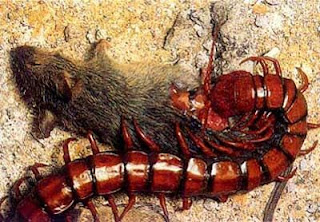
Image from: http://spluch.blogspot.com/2007/01/giant-centipedes.html
Centipedes are even worse. I encountered centipedes in one memorable Cthulhu adventure and it was a very close call - they are extremely fast and aggressive. Add to that the fact that they have a poisonous and painful bite, can walk up walls and on the ceiling and that they can raise themselves on the last three leg pairs and you have a monster no-one will forget. Here's a video of a giant centipede catching a bat in flight while the centipede is hanging from the ceiling of a cave. Scolopendra.be has more infomation on them, as has Arkive.

Assassin bugs are great, too - not only do they look like aliens, they also have an extremely painful sting and can hit your eyes with a defensive liquid from about a foot away (millipedes can do that, too). An assassin bug will wait for its prey to walk by, coming closer very slowly and will then attack in the blink of an eye, ramming that long and sharp proboscis into their prey. Think Brain Bug. Here's a video of an Assassin Bug in action. With that image stuck in your head, you can find out more at Assassinbug.com.

Speaking of Starship Troopers, Bombardier Beetles are really weird and were the inspiration for the Tanker Bugs, the ones that shot flaming liquid from their mouth. Bombardier beetles can't shoot flames, but if you pester one too much, you will get sprayed with a hot gas that is definitely painful if you get some in your eyes or on your skin. The beetle stores hydroquinone and hydrogen peroxide in two separate chambers in its body, mixes them in a third chamber and the mixture heats up to about 100°C/212 °, becomes gaseous and then gets fired at the attacker. Don't think you're safe if you're in front of the beetle. It can swivel the firing gland between its legs or over its back. Oh, and it can repeat the attack multiple times per second. Here's an article with some cool pictures of the process

Some nice Cornish Mussels courtesy of Wikimedia
Mussels - yeah, right. What can they do, except give you food poisoning? Apart from being a lot more mobile than people think, here's a mussel that gives me nightmares. Forget killer clams (the most inoffensive animals ever, whatever Doctor Who may want us to believe), clampires are the way to go. You can find more photos of mussels of various types and sorts at the Unio Galleries.

Image from: http://www.bgsd.k12.wa.us/hml/jr_cam/macros/tl_pond/tl_pond.html
And finally, dragonfly larvae. Two words: extendable jaws.

Creative Commons License
Jennifer's Monsters by Bookscorpion is licensed under a Creative Commons Attribution-NonCommercial-ShareAlike 3.0 Unported License.
Based on a work at oldschoolheretic.blogspot.com.
Permissions beyond the scope of this license may be available at http://bookscorpion.deviantart.com/.

Sunday, December 5, 2010

Exploration Versus Murder, Theft and Vandalism

Some wandering, meandering random thoughts concerning experience and exploration in RPGs.

Exploration is a subject that is near and dear to my heart, and it forms a major theme within the Riskail setting.  But the sort of exploration that I've come to expect from games set in Riskail isn't the same animal that one might expect from OD&D and all it's iterative-mutantive dark young.  (IA! IA!)

Kill the monsters and take their stuff seems to be just peachy-keen to a large segment of gamers.  It's intrinsically bound-up inside the very DNA of the game.  Like Trollsmyth said way back in 2008 in his excellent post What Is This Game Supposed To Be About?  It's about exploration, but it is also very explicitly part and parcel of the whole she-bang that any exploration carried out in the game directly in the service to theft and murder, with the occasional bit of vandalism tossed in for good measure.

OD&D was built-up from the core principles of Exploration, Murder and Theft.  Killing monsters was originally tangential to exploring the dismal deeps and looting them.  The real emphasis, in terms of what the rules really rewarded, was in the Theft end of the triumverate of antisocial values near and dear to the heart of OD&D.  The Experience Points accumulated from lugging in massive sums of gold beat what you could earn from smiting hordes of creepy-crawlies or their masters.  And like anything else, you get what you pay for--those actions that get the highest rewards are hard-wired into the game as preferred activities.  Deviating from those things results in lesser rewards, which in effect is akin to being punished for not going along with the program.

But rewarding Theft/looting isn't necessarily the best way to reward exploration.  Or is it?  Tying advancement to money is ultra materialistic, and a dangerous abstration that reinforces some unpleasant and potentially unwelcome tendencies amongst the impressionable young minds being exposed to these questionable messages.  Exploration in the service of Theft backed-up by Violence is about as thuggish a message as you can pass off as 'harmless entertainment,' which ultimately it really isn't, not when you systematically reward and encourage these kinds of activities over more socially responsible, positive and healthy things.  But the debate about morality and all that stuff has been raging ever since the first set of Little Brown Books got shipped out into an unsuspecting world.  I'm not interested in rehashing that old chestnut.  I'm interested in some sort of alternative to the entrenched pseudo-psychotic emphasis on murder and theft.

But how do you make the role-playing of the creation of a work of art (for example) interesting, let alone exciting?  How does one re-orient the game from theft and murder to more creative, positive and worthwhile activities--and how do you do that without chugging on over to mamby-pamby land while you're going about it?

Endless tables for simulating social interactions leave me cold and unsatisfied.  Rules that try to replace human interaction more appropriately belong in a computer game, even a board game, but not a paper & pencil RPG with real living, breathing people gathered around the table.

Coming up with alternatives to rewarding ought-right murder in an RPG ought not to be so difficult, but it certainly seems to be. Quick: name one popular (playable) RPG that does not reward theft and murder.  If you can name one RPG that does this successfully and remains worth playing--please, do let me know.  I'm very interested.  The expectation that killing monsters, slaying dragons and engaging in combat against the forces of darkness is hard-wired into the core of the literary corpus from which OD&D arose, and all that has come up from out of that tiny little acorn that gave birth to role play gaming.  The Quick Primer to Old School Gaming by Mr. Finch does an excellent job of summing-up the way that old school gaming is Approached and Actually Played from an OD&D/old school perspective, but it doesn't go any farther than that.  (the free PDF is here, just in case.) The excellent RetroRoleplaying blog offers a nice addendum to the Quick Primer that expands the viewpoint into the arenas opened-up by Tunnels & Trolls, etc. And that's a nice place to start, but it doesn't really address the matter from the particular angle that I'm looking at things from, so I'll have to go dig a little deeper.  Every subsequent edition and all the retro-clones included have a definite, no bones about it emphasis upon theft and murder as the primary activities that result in experience, advancement, power and wealth.

But that's not enough.

Not by a long shot.

For one thing gaining power by notching off how many critters you've hacked to bits is fairly stupid, not just unrealistic which isn't the problem, but downright stupid.  Power ought to be gained through accomplishment, acclaim, and contributions to society/civilization that are meaningful and worthwhile.  Killing the hordes of enemy monsters is one way to preserve civilisation, but it will never rebuild any roads, nor educate any kids, or put food on the table (aside from goblins in the pot or jugged orc, yeck!).

Violence is far more visceral and immediate and luridly seductive, especially to the adolescent psyche or the grognard alike. It's a very human thing, a very intimate part of life itself. It's also an inherent component of Surrealism, so it's staying around in Riskail, especially now that I've started to look at J. G. Ballard as more than just another boring literary author other people name-check but don't really read.  For one thing, Ballard isn't boring.  But that's a tangent for another post.  I have no interest in getting rid of, nor replacing violence--it's a core tenet of the setting, and a primary reality that I ahve no interest in denying.  But I do want some way of rewarding acts other than wanton violence and bloodshed.

But I still want to suss-out a really effective way to reward the behaviors appropriate to the setting, and to encourage more of the type of gaming decisions and character efforts for which I'm comfortable awarding experience points.  Unless you're Jet Li, it's not going to make you ultra powerful to just kill things or people. 

The process of coming up with a super invention that some superhero RPGs use might be a place to start, but honestly, most of those sub-systems manage to suck the excitement right out of the room. Tunnels & Trolls awarded XP for exploring levels of dungeons, and Rolemaster gave you a point for every mile you traveled, and for other things, but neither are very satisfying solutions in and of themselves--covering ground isn't the point.  Especially when you can extrude an ultralight from nanoplasm or step through a gate and cover millions of miles very quickly and effortlessly.  The distance isn't important, in and of itself.  What you've done at that distant locale, and what you've brought back--that's interesting and worth a reward, depending on just what you did.  Coming back with detailed maps, journals, samples of the local flora and fauna, compiling paintings of the wildlife like Audubon or Peterson, doing portraits of the natives like Catlin, opening up trade routes like Marco Polo, discovering exploitable political opportunities like Cortez (there's that violence thing again...), bringing back more than just your own scarred carcass similar to Lewis & Clark...that's more along the lines I'm thinking about.  Stuff that no one else has ever done, ever seen, or ever had access to before--that's where the whole Novelty as a Commodity aspect of the economy kicks in and takes off in a big way.

Explorers document their expeditions.  In Riskail they have access to GIS, Geocaching, satellite surveillance, holographic cartography, memory recording, UAVdrones, millions of varieties of cameras, and more. Much more.  There's no excuse for not documenting things thoroughly.  Especially when they can auction-off the package to feuding factions of Academics, Scholars and Researchers.  Hopefully the party has decent security so no one gets assassinated, deleted or corrupted...

The Omnipotent Eye blog offers several good posts on Exploration and Experience which are available in their archives.  A Paladin in Citadel likewise has ruminated on this matter of Experience in a very thoughtful manner, in particular in this post on Killing Things and Taking Their Stuff.

Rewarding Exploration is a good approach, and one that I have dabbled with over the years and have found to work very well--so long as you set things up to support wide-ranging parties of explorers who are prone to run off of the prepared maps at a moment's notice. (I've had a lot of fun with parties that deliberately sought out opportunities to go off-map at the first opportunity, and that sort of informed improvisation is something that I personally, really and truly enjoy immensely.)  Matthew Slepin has also written quite a bit about experience and advancement that he has provided an index to his various posts regarding these matters as well as discussing his views on awarding XP for exploration.  Jeff Rients likewise has weighed-in on this matter with some very cogent observations and insights on how to award XP for having visited exceptionally weird/dangerous/exotic/cool places such as certain hexes within the Carcosa setting in particular.

But to handle the Exploration-based XP scheme, you need a decent sandbox, and one of the Masters of Sandbox design is Rob Conley over at Bat in the Attic, and he offers a decently concise definition of the term sandbox here.  As work proceeds on Zalchis, thoughts of sandboxes replace sugar plums, but we'll dig into some serious sandboxification later.

Exploration is the key to breaking the monopoly that theft & murder have held over advancement in RPG-terms, it's not the only key, maybe not even the best one, but it is where I've started and apparently I'm not alone by a long shot.

Monday, November 22, 2010

RPG Brainstorming: Some Real-Life Monsters


The world around us is a far more weird and wonderful place than most of us ever realize.  Below are a few peculiar items lifted from YouTube to spark your creativity. I'm already thinking up a scenario that combines all of these critters into a set of linked encounters...


Ouch.  Enough said.


These are shrimp for crying out loud...Shrimp...save versus shrimp?  The thing just snaps its specially-modified claw and the resulting implosion of air bubbles temporily reaches the temperature of the surface of the sun.  You can't manage that with a Zippo lighter at a Lynnerd Skynnerd concert.  (Freebird!)  Anyone making-up this sort of critter would very likely get laughed at and then punched.  Hard.  Repeatedly.  But it's real, and now you have proof of it courtesy of the BBC. 


Drunk Monkeys.  Another denizen lurking in some dimly lit corner of an inn, bar or gin-joint near you--some of them aren't just drunks, though, some of them belong to thief-troupes...and they might have friends amongst the roving bands of Rogue Baboons...


Breakdancing skunks, or could it be olfactory capoeira?  That's some dance of defiance.


Okay, maybe these would work just fine, especially if they were enlarged and perhaps trained by some sort of aquatic being to serve as guards along the shoreline or in the midst of a really big mangove swamp...best not be carrying a lantern near that pool...


Now this is just too good not to use for an encounter.  Wonder who'd train and use such critters as mounts?  A good critter to summon for a quick get-a-way as well, if you can call up a big enough specimen...


Parasitic fungi that infect the victim's body and mind--and it's real--and there are over a thousand vrieties that are out there, possibly one that can convert PCs into weirdly elegant sculptures.  It's not just Yuggothian Mi-Go that you need to worry about...

Let me know if you found any of this useful.

Friday, February 26, 2010

Something of a Beginning

Let me begin with a couple of quotes:

“Gary Gygax never played AD&D as published, so why the hell should we care so much about that system? Or why should we give a rat’s ass about cleaving unto the systems offered by the lesser lights that followed him? Furthermore, I reject as ridiculous any argument that the original Gygax campaign ever played OD&D as published. Have you read OD&D lately? I can’t believe that anybody can play it as it appears on the page. It’s a goddamn mess. A glorious one, full of wonder and mystery, but a mess nonetheless.”
Jeff Rients, Jeffs' Gameblog, Tuesday, August 11, 2009 
“To me the Old School Renaissance is not about playing a particular set of rules in a particular way, the dungeon crawl. It's about going back to the roots of our hobby and see what we could do differently. What avenues were not explored because of the commercial and personal interests of the game designers of the time.”
Rob Conley, Bat In The Attic

----------
I'm not used to agreeing with very many people, but I find myself agreeing with these two gentlemen above, at least in respect to these two quotes.  The game that Gygax and Arneson both ran as DMs bore only a superficial resemblance to the game that they passed on to us, and for good reason: they were creating a framework for people who did not necessarily have an exhaustively encyclopedic grasp of the fine details of medieval pole-arms, military history, or deep immersion in pulp fiction that they brought to the table.  It is, was and always will be a jumping-off point, not an end-point destination.  I believe I read somewhere that Tim Kask once stated "D&D was meant to be a free-wheeling game, only loosely bound by the parameters of the rules."  That sums things up very nicely.

It's all about imagination.  The first iteration/edition of D&D was definitely a glorious mess full of wonder, whimsy and mystery that still sparks imagination and spurs creativity while providing a great deal of entertainment and enjoyment.  That's a very cool thing.

After taking some time off from gaming, I was boxing-up some dusty D20 books and stuff in order to make more room for other things that were more pertinent to my work, and in the course of packing-up a bunch of glossy-covered manuals I re-discovered my copies of the Little Brown Books and the first few OD&D Supplements.  I glanced through them, then set them on a shelf and finished clearing-away the debris and got on with other things.  A few months later I took them down off of the shelf and started to re-read them from front to back.  Something was nagging at me.  It was the quote from the Foreword from Men & Magic that I have placed on the upper-righthand of this blog.  Silly, innocuous, even obvious...those words have proven to have been extremely influential upon me ever since I first laid eyes on them back around 1978-79.  (Thanks Tim!)

Editions and editors have come and gone, Gygax himself reversed himself later on, but none of that mattered: the cat was out of the bag and having started-out with the Little Brown Books, I will always approach Role Playing Games as tools and means for the exploration and expression of my own worlds, not the slavish recreation of settings mandated by corporations seeking to dominate their customers' brain space even more perniciously than anything IBM or Microsoft ever dared attempt.

Old School, in terms of D&D, has always been about doing your own thing, building your own worlds, running your own setting, and cobbling together your own rules.  Over at Eiglophian Press they're calling it Imaginative Anarchy.  I like that.  You can almost hear the Sex Pistols in the background...at least I can...what a glorious mess!